▶ TL;DRSeason of Divine Intervention is Diablo 4 on autopilot. The systems are cleaner, the itemisation is better, the early game is harder – but it's still the same seasonal formula Blizzard has been running since launch. Collect powers, slot powers, grind content, repeat next season. The Paladin paywall is the real story here. Locking an iconic, beloved class behind a pre-order for an expansion that's five months away is the kind of decision that prioritises revenue over player goodwill. It's not illegal, it's not even surprising for Blizzard in 2025 – but it is disappointing. Diablo 4 isn't a bad game. It's a competent, polished ARPG that offers dozens of hours of demon-slaying entertainment. But "competent" and "polished" aren't enough when your competition is doing more interesting things for less money. Season 11 is fine. And that's the problem.
Overview
Diablo 4's eleventh season arrives with a familiar promise: new powers, new systems, and a fresh reason to grind through Sanctuary again. Season of Divine Intervention brings Lesser Evil invasions, Divine Gifts, a reworked itemisation system, and the long-awaited Paladin class. On paper, it sounds substantial. In practice, it's another season that follows the exact same formula Blizzard has been recycling since launch – and this time, they've locked the most exciting content behind a pre-order paywall.
+ PROS
- Tempering/Masterworking rework removes frustration
- Defence system is clearer and more intuitive
− CONS
- Paladin locked behind $40+ expansion pre-order
- Same "collect powers, slot powers" seasonal formula
The Paladin Problem: Pay to Play Your Favourite Class
Let's address the elephant in the room first, because it's impossible to discuss Season 11 without talking about how Blizzard chose to release the Paladin.
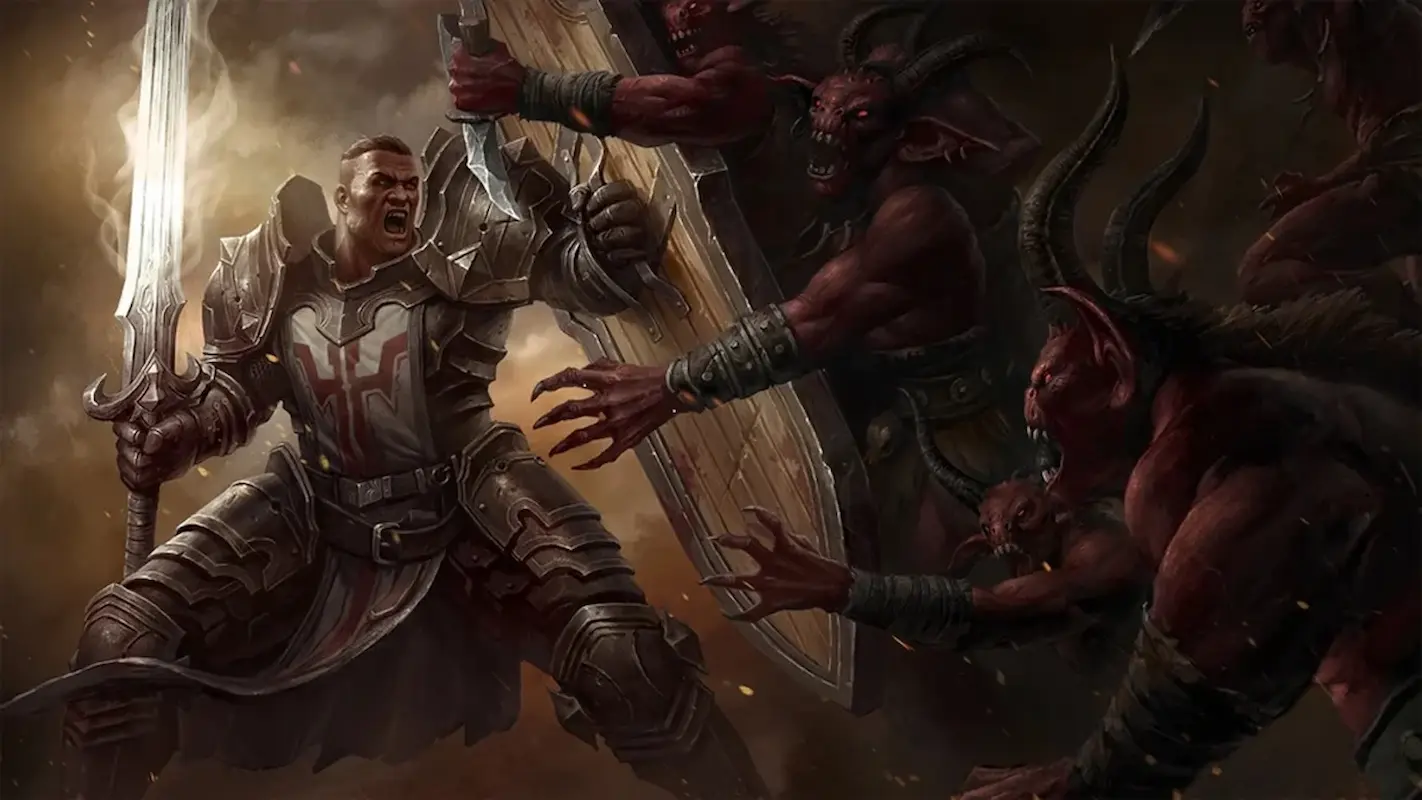
The Paladin – one of the most iconic classes in Diablo history, dating back to Diablo 2 – is now available in Diablo 4. Great news, right? Here's the catch: you can only play it if you pre-order the Lord of Hatred expansion, which doesn't even release until April 2026. The minimum buy-in is $40 for the Standard Edition. Want the fancy mount and cosmetics? That's $80 for the Ultimate Edition.
This is, frankly, predatory.
Blizzard timed the Paladin reveal for The Game Awards, dropped it alongside the Season 11 launch, and made it immediately playable – but only for those willing to pay for an expansion five months in advance. They're not selling you the class; they're selling you the privilege of early access to content that should arguably have been in the base game from the start.
The Paladin was in Diablo 2. The Crusader (a Paladin variant) was in Diablo 3. When Diablo 4 launched without a shield-wielding holy warrior, fans were told to wait. When Vessel of Hatred released, we got the Spiritborn instead. Now, finally, the Paladin arrives – and it's locked behind a pre-order for yet another expansion.
For a game that already costs $70 at base, with a battle pass every season, a cosmetic shop with $25 armour sets, and an expansion that was $40-$100 depending on edition, this feels like Blizzard testing exactly how much they can extract from their playerbase. The answer, apparently, is "a lot."
Divine Gifts: Powers Upon Powers Upon Powers
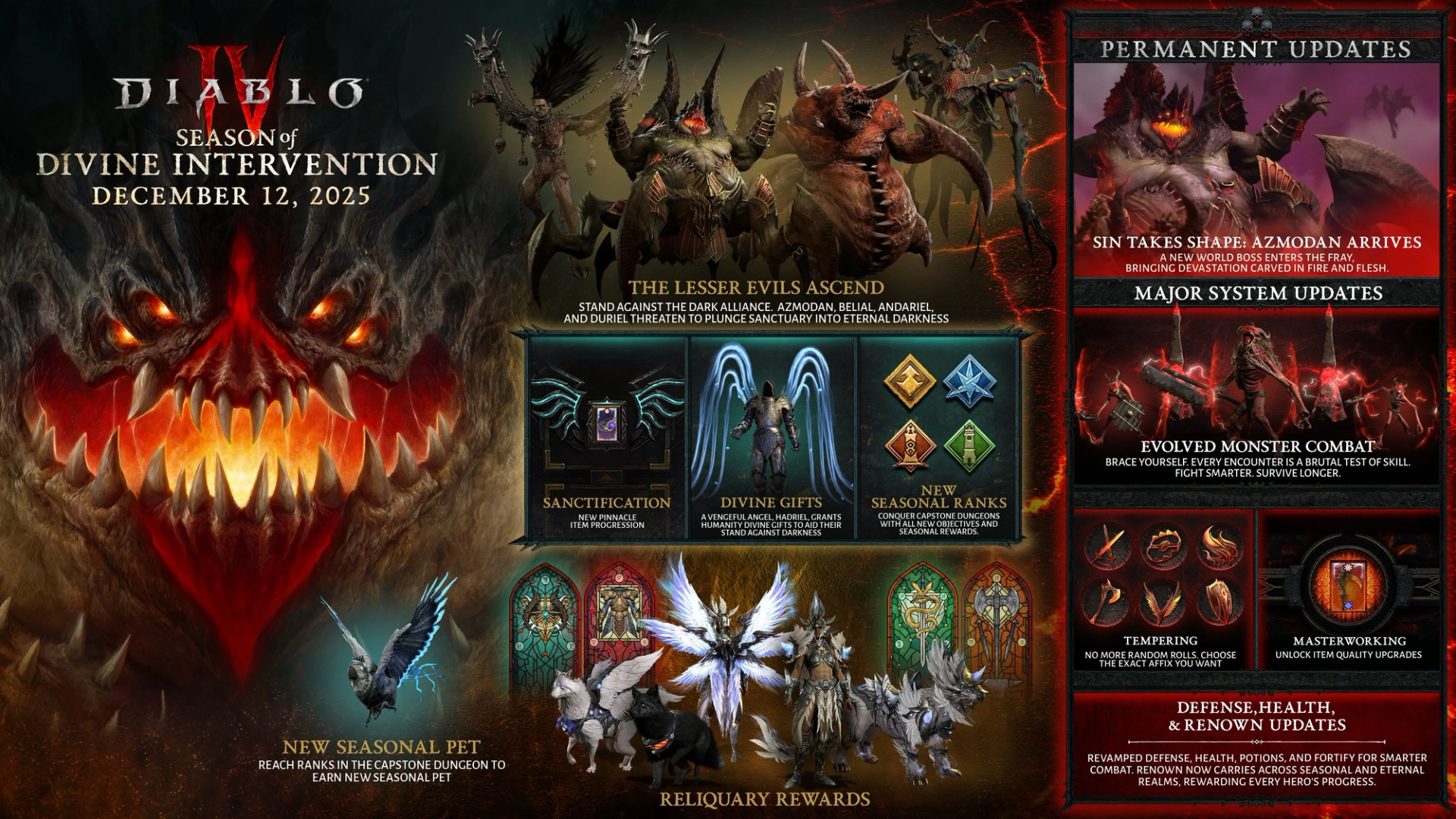
Season 11's headline mechanic is Divine Gifts – celestial boons granted by the angel Hadriel to help you fight the invading Lesser Evils. Each of the four Lesser Evils (Azmodan, Duriel, Belial, and Andariel) drops Corrupted Essence when defeated, which you bring to Hadriel to unlock two Divine Gifts per boss.
Here's how it works:
- Slot gifts in the outer ring for Corrupted Gifts (harder content, better rewards)
- Slot gifts in the inner ring for Purified Gifts (positive bonuses, doubled rewards)
- Level up gifts by killing the corresponding Lesser Evil and their minions
Sound familiar? It should. This is the exact same seasonal template Blizzard has used for nearly every season since launch:
- Season 2: Vampiric Powers
- Season 3: Seneschal Construct powers
- Season 4: Iron Wolves powers
- Season 5-10: Various iterations of "collect thing, slot thing, gain power"
- Season 11: Divine Gifts
It's powers. It's always powers. Collect the things, slot the things, get stronger, grind the same content slightly faster. Rinse and repeat every three months.
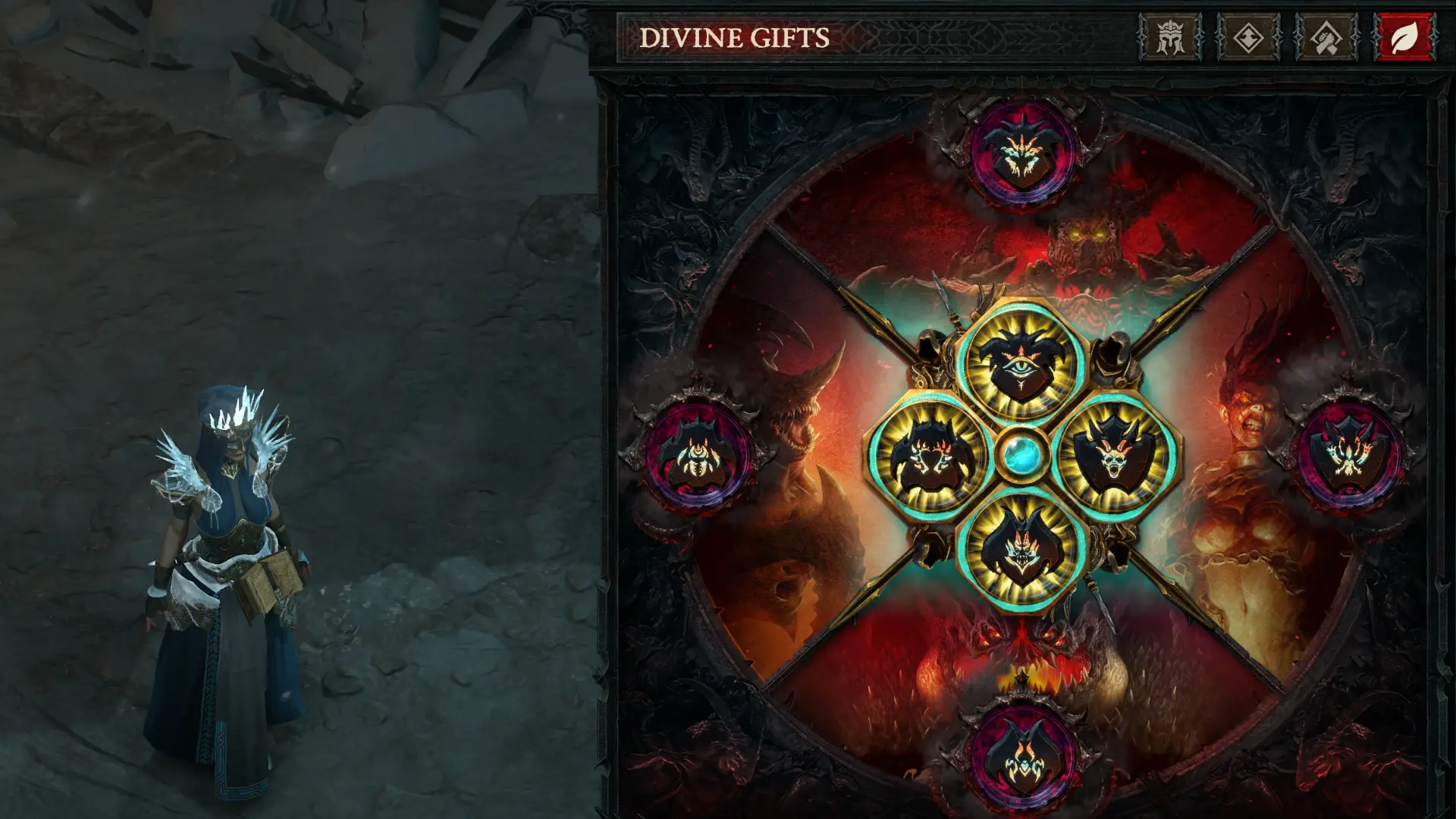
The Divine Gifts themselves are fine. Some offer genuinely interesting trade-offs – Duriel's Essence of Pain makes Helltide drop more socketables but also spawns constant ambushes. There's strategic depth in choosing which corrupted penalties you're willing to accept for better rewards. But after eleven seasons of essentially the same loop, "fine" isn't enough anymore.
The Lesser Evil Invasion: Recycled Bosses in New Locations
The seasonal hook is that Lesser Evils have invaded various endgame activities:
- Duriel replaces the Blood Maiden in Helltide
- Belial takes over The Pit
- Andariel lurks in The Undercity
- Azmodan becomes a summonable world boss
On the positive side, fighting actual named demons from Diablo lore instead of generic bosses is more engaging. Azmodan as a world boss with customisable difficulty (you can infuse him with other Lesser Evil powers) adds some variety. There's even a hidden Uber version of these fights tied to a community puzzle that was genuinely fun to solve.
But let's be honest about what this actually is: existing bosses reskinned and placed in existing content. The Pit is still The Pit. Helltide is still Helltide. You're doing the same activities you've been doing for a year, just with different names attached to the boss at the end.
System Overhauls: Finally, Some Good Changes
Credit where it's due – the itemisation changes in Season 11 are legitimately good:
Tempering Rework:
- You now choose exactly which affix you want instead of random rolls
- Items can only have one temper, but infinite retempers via Scrolls of Restoration
- Greater Tempers (50% bonus) can roll randomly
Masterworking Rework:
- New "Quality" stat (0-25) increases base damage/armour/resists and all affix values
- Capstone bonus at max quality boosts a random affix by 50%
- Cleaner, less frustrating than the old system
Sanctification:
- Final upgrade step that locks an item permanently
- Grants one of five potential improvements
- Essentially Diablo 4's version of PoE's Vaal Orb
Defence Rework:
- New Toughness stat summarises your effective HP against each damage type
- Armour now reduces all damage types, not just physical
- Clearer, more intuitive defensive scaling
These changes address long-standing community complaints. Tempering was frustrating, masterworking was confusing, and defence calculations were opaque. Season 11 fixes all of that.
But here's the thing: these are quality-of-life improvements to existing systems. They make the game less annoying to play – they don't make it more exciting. There's a difference between "I'm not frustrated anymore" and "I'm having fun."
Monster Combat: Harder, But Still Hollow
Blizzard made monsters smarter and harder in Season 11:
- Over 20 new affixes
- Elite packs with more threatening compositions
- Reduced monster clumping (your AoE is less effective)
- Increased damage across the board
The early game is genuinely more challenging now. You can't just sleepwalk through the campaign anymore. But once you hit endgame and your build comes online, the difficulty evaporates. You're still zooming through maps, still one-shotting screens of enemies, still grinding the same dungeons for the same loot.
The fundamental problem with Diablo 4's difficulty isn't that monsters are too easy – it's that the power curve is too steep. No amount of buffing monster damage fixes the fact that a well-geared character trivialises everything. And then you're back to the real Diablo 4 experience: watching numbers go up while doing the same thing you did last season.
The Endgame Problem Persists
Season 11 adds some new endgame content:
- The Tower – A timed, multi-floor dungeon with leaderboards
- Capstone Dungeons – Five new dungeons that gate difficulty tiers
- Season Rank – Replaces Renown with objective-based progression
The Tower is the closest thing to fresh content here. It's basically a race through randomised floors, collecting orbs for score, with leaderboards to track performance. It's fine for competitive players, but it's still just "kill monsters fast in a dungeon" with a timer attached.
Capstone Dungeons are an improvement over the old difficulty gating system. Having actual content to clear instead of just hitting level thresholds makes progression feel more earned.
But none of this addresses the core issue: Diablo 4's endgame is still shallow compared to its competitors. Path of Exile 2 launched a week later with the Fate of the Vaal league, offering temple-building, strategic dungeon construction, and meaningful choices that affect your rewards. Meanwhile, Diablo 4's endgame is still "run Pit, run Helltide, run Nightmare Dungeons, repeat forever."
The Path of Exile 2 Elephant in the Room
It's impossible to ignore that Blizzard deliberately launched Season 11 hours before PoE 2's Druid patch. The timing wasn't coincidence – it was competition.
And honestly? Diablo 4 loses that comparison badly.
PoE 2 offers a new class (Druid) for free with its patch. Diablo 4 locks its new class behind a $40+ pre-order. PoE 2's league mechanic involves strategic temple construction with meaningful player agency. Diablo 4's seasonal mechanic is another power-slotting system. PoE 2 is technically still in Early Access and already offers more build diversity than Diablo 4 does two and a half years post-launch.
If you have to choose between the two this season, the choice is obvious.
Who Is This Season For?
If you love Paladin and don't mind paying: The class itself is excellent. Tanky, versatile, with satisfying Holy abilities and multiple viable builds. The $40 asks a lot, but if shield-wielding crusaders are your thing, you'll enjoy it.
If you're a returning player: The itemisation changes are worth experiencing once. The QoL improvements make gearing less frustrating. But the core loop hasn't changed.
If you're burned out on D4: Nothing here will change your mind. It's the same game with different seasonal flavouring.
If you've never played D4: Wait for a sale. There's fun to be had, but not $70 worth at this point.
Reviewed on PC. Diablo 4 base game and Season 11 are available now. The Paladin class requires pre-purchase of Lord of Hatred ($40+).
Life Meets Pixel is an independent gaming publication. We don't accept sponsorships and call out monetisation practices when they cross the line.


PLAYER COMMENTS
LOADING...